
Wednesday, July 10, 2013
Lynda class excerpt: An explanation of Fitts law
Fitt's created an equation for location (proximity, really) and size of UI elements and their relationship to how easy they are to select. Sometimes buttons should not be easy to select (a great example is provided in this video for industrial equipment).
I't's a classic example of science in user experience and one that is dear to my heart.
Is it obvious? It's certainly logical....but test your skills by attempting to answer the instructors question correctly at 1:50. If you got it right, awesome!

Thursday, June 20, 2013
User momentum
The first time I played Crazy Taxi I was shocked at how great it was.
When you crash your car, you just kept on going! You knock over a shopping cart? No big whoop.
Awesome.
Previously, car games would go through a huge, punishing rigamarole if you so much as tapped another vehicle, never mind flipped over on a cactus. You'd have to wait for the whole thing to reset (Mario Kart I'm looking at you).
But Crazy taxi just let you keep driving. It was really cool to keep your momentum and simply be told "by the way you hit something, I'm taking some points off FYI".
Too many restrictions and errors in an interface feel like you're making a big deal out of something you care about but the customer doesn't.
For the love of Peet, only show errors when you absolutely must. As often as possible opt for warnings or informational messages when things might be wonky.

When you crash your car, you just kept on going! You knock over a shopping cart? No big whoop.
Awesome.
Previously, car games would go through a huge, punishing rigamarole if you so much as tapped another vehicle, never mind flipped over on a cactus. You'd have to wait for the whole thing to reset (Mario Kart I'm looking at you).
But Crazy taxi just let you keep driving. It was really cool to keep your momentum and simply be told "by the way you hit something, I'm taking some points off FYI".
Too many restrictions and errors in an interface feel like you're making a big deal out of something you care about but the customer doesn't.
For the love of Peet, only show errors when you absolutely must. As often as possible opt for warnings or informational messages when things might be wonky.
Monday, June 3, 2013

Sunday, June 2, 2013
Remotes are out of control
I keep seeing images like this all over the web. Usually with the caption "How I got my mom/dad/grandma grandpa to stop asking me how to use the remote."
Society is crying out "there are too many buttons on the remote. Let's face it, there are way too many buttons that aren't relevant. Not just for Grandma, but for nearly everyone.

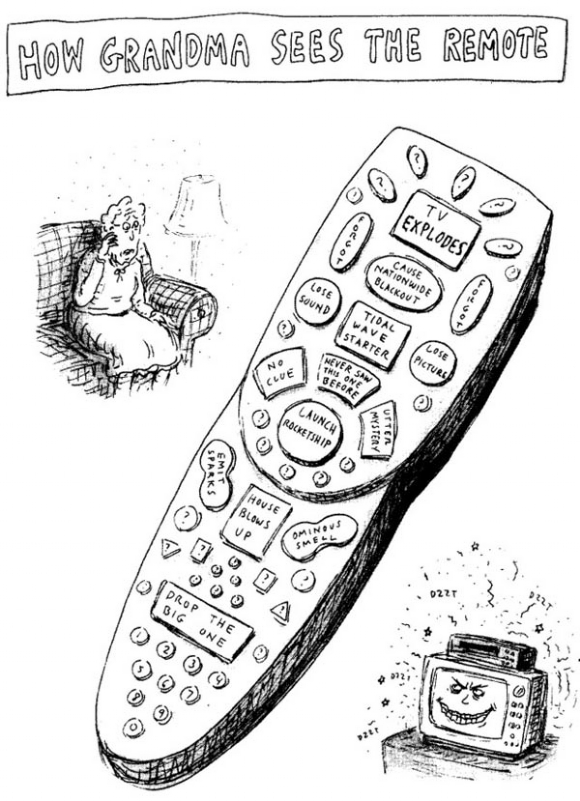
Society is crying out "there are too many buttons on the remote. Let's face it, there are way too many buttons that aren't relevant. Not just for Grandma, but for nearly everyone.
Thursday, May 16, 2013
Thursday, January 24, 2013
"Ew, Get an office!"
As a contractor/small business owner/entrepreneur/consultant/studio owner/principle or whatever title the situation demands, I work from home 95% of the time.
This means:
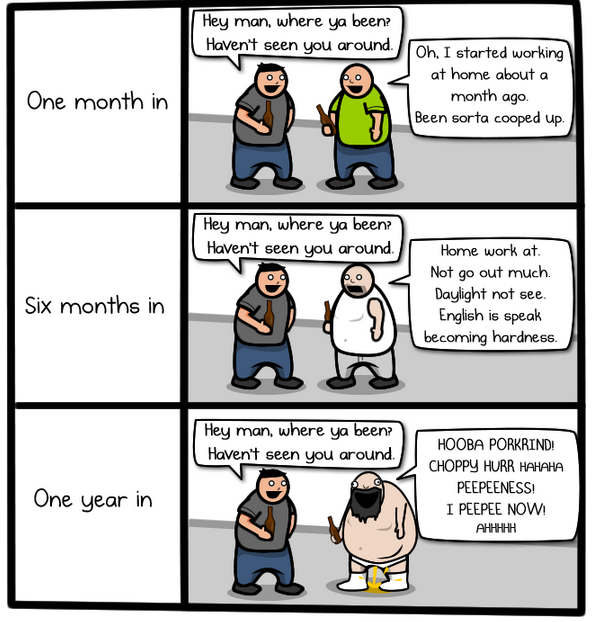
So, I've broken down & got a space at Tech Liminal. Oakland's solution to pajamas-all-day, keyboard stomping cats, blenders, and poor grooming. I'm here now, with jeans and shoes. I should brush my teeth next time. ; )
This means:
- Every time I get up to use the restroom/eat my cat is on my keyboard smooshing every key she can and while I'm working, she's jumping up trying to walk on it. "KITYY!!!" I yell and gently toss her to the side at least five times per day.
- Once when I yelled "Kitty" my mute button was not on and I was in a phone conference.
- Every time my husband blends his breakfast smoothie, vacuums, or plays his music and I'm in a meeting I want to plug my ears.
- I wear pajama bottoms and socks.
- My hygiene could be...better.
So, I've broken down & got a space at Tech Liminal. Oakland's solution to pajamas-all-day, keyboard stomping cats, blenders, and poor grooming. I'm here now, with jeans and shoes. I should brush my teeth next time. ; )
Tuesday, January 15, 2013
Scene from an airport
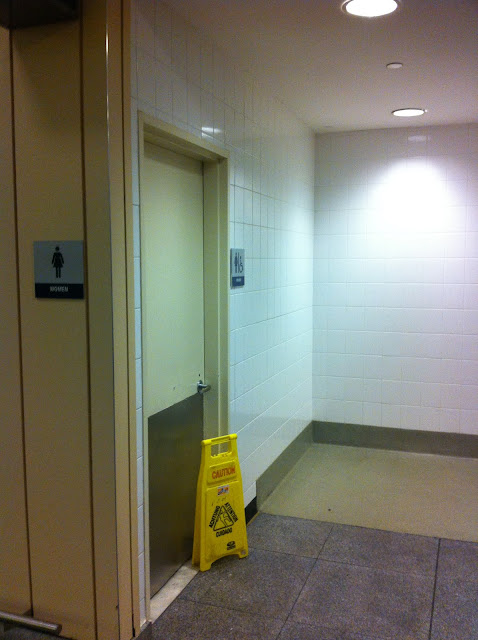
Guess what this yellow sign is for.
I'll give you a minute.
Take your time.
I'll give you a minute.
Take your time.

OK, For those of you stumped, the yellow sign is to prevent someone from walking into the janitor's closet. The women's restroom is actually strait ahead and to the right.
This makes me want to repeatedly hit my head (ideally, on the wall with the lying placard).
Instead of the airport changing the placards so they don't lead a stream of women to the wrong place, the folks responsible for cleaning the bathroom have fixed it themselves, quite cleverly.
A workaround.
Monday, January 14, 2013
Where the fuck are the Olives?
We naturally thirst for deeper and alternate ways to solve problems. I found these two images on separate Reddit posts recently. The caption on both was something like "Why isn't this on every shopping cart?"
All I could think was "Yup."
All this information is already in the store, technically, since the isles contain the categories, yet a map and index are useful because they'd be right in front of you, deepening the solution set and anticipating a common and frustrating grocery store problem. For example: "Where the fuck are the olives?"
Consider some of the ways we might approach searching for olives in a store:
Also, a bigger question, what about searching problems that are more difficult than olives (search by gluten-free, kosher, good for kids, etc)*?
What's interesting about the shopping map posts on reddit (it appeared once then was reposted 9 months later) is the incredible response from the reddit community. Over 1,600 people had something to say about having maps on shopping carts, and over 10,000 people agreed with this.
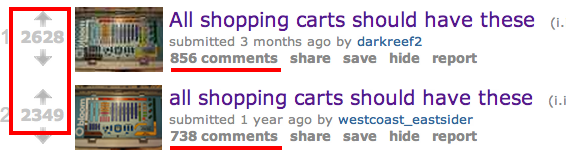
Wow.
Digging into the comments reveals something even more interesting. While an on-cart map is generally considered awesome and overdue, people felt grocery stores don't want you to have it. The top comments (reddit uses an upvoting system) are about how on cart maps are against store goals for earning. Check them out:
and
Huh, so the customer experience is seen by customers to be at odds with business goals and the reason why the can't expect excellent experiences.
We know as UX practitioners, this isn't true. Excellent customer experiences are tied tightly with return on investment (if you do not know this, . In other words, companies with great customer experiences do better financially.
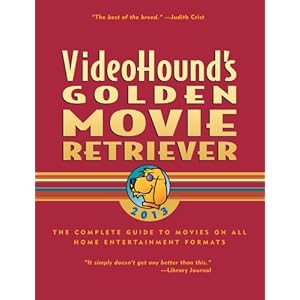
*Category search is vastly underrated. Speaking of category search, IMHO, the best category movie index is VideoHound; sure they cross-list actors, directors, etc (IMDB does this) but they list movies by really cool categories, such as Chicago, NYC, Soccer, Friendship etc. Vastly important when you remember only that it had to do with Gymnastics and you saw it as a kid in the 80's. Answer: Nadia.
 |
| Index of items by aisle. |
 |
| Map of store. |
All I could think was "Yup."
All this information is already in the store, technically, since the isles contain the categories, yet a map and index are useful because they'd be right in front of you, deepening the solution set and anticipating a common and frustrating grocery store problem. For example: "Where the fuck are the olives?"
Consider some of the ways we might approach searching for olives in a store:
- walk the edge of the store reading each aisle description
- walk the edge of the store looking at the stuff on the edge of the asiles and go down aisles which seem to have things which are similar to olives
- walk the entire store (brute force)
- ask an employee (or a person dressed as an employee)
And how each person might approach this problem and how one person would vary their approach based on many factors. I, for example, sometimes jump right to #4 unless I don't feel like talking to anyone then #4 is my last resort). We all know someone who would never do #4, don't we?
| I *might* be overdoing the UX memes. |
What's interesting about the shopping map posts on reddit (it appeared once then was reposted 9 months later) is the incredible response from the reddit community. Over 1,600 people had something to say about having maps on shopping carts, and over 10,000 people agreed with this.
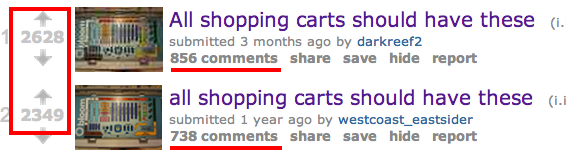
Wow.
Digging into the comments reveals something even more interesting. While an on-cart map is generally considered awesome and overdue, people felt grocery stores don't want you to have it. The top comments (reddit uses an upvoting system) are about how on cart maps are against store goals for earning. Check them out:
 |
| See full comments from original post |
and
 |
| See comments from repost |
Huh, so the customer experience is seen by customers to be at odds with business goals and the reason why the can't expect excellent experiences.
*Category search is vastly underrated. Speaking of category search, IMHO, the best category movie index is VideoHound; sure they cross-list actors, directors, etc (IMDB does this) but they list movies by really cool categories, such as Chicago, NYC, Soccer, Friendship etc. Vastly important when you remember only that it had to do with Gymnastics and you saw it as a kid in the 80's. Answer: Nadia.
Wednesday, December 12, 2012
Monday, December 10, 2012
Psychological impact of origin
How important is the history, context, and origin of an experience? If you believe Paul Bloom, it's nearly everything to our brain.

Subscribe to:
Posts (Atom)